


The Konstrui Design Process
- Johann Torres
- Sep 23, 2019
- 5 min read

Hiring an architect and/or interior designer might look expensive and even unnecessary (except for the application of building permit as an architect's sign and seal is needed), however, trying to look at the different stages within a design project will make you realize how many different skills and problem solving are needed to be able to successfully finish a project -- from assessing the client's requirements and needs, researching and understanding the brief, space planning, designing, documentation, project monitoring to assisting client upon moving in.
In this post, we will guide you in understanding the whole design process within our team and what to expect on each stage.

Our design process is composed of 5 stages: Schematic, Design Phase, Design Development, Construction Phase, and Setup/Project Reveal Phase. Due to the nature of our process, our team has the flexibility to work on all stages or will depend on the client's needs (some clients opt to skip some phases or until a certain stage only). Customarily, we will recommend that we be involve in the whole design process, so we can ensure that the design will be followed through and the client brief will be met in all aspect of the project.

Upon the start of the project when our team and the client agree on the final contract and deliverables, we start with the Schematic Phase. This is the stage where we will need all necessary documents to make our proposed concept board. Usually, we will ask the ff documents:
1. As-built Architectural and Engineering Plans. We will also schedule an initial site visit and do an actual measurement of the space, noting all existing conditions as well as available provisions for utilities such as electrical, plumbing/sanitary, mechanical, fire protection, security, etc.
2. Construction Guidelines. This is applicable mostly for residential and commercial, retail, rentable/leasable spaces in condominium buildings and commercial buildings (malls, medical arts building, etc.), and houses situated in subdivisions. In the construction guidelines, we can check what requirements are needed to process the permits needed prior to construction, as well as know the limitations of the project in terms of the design and during the construction phase.
3. TCT or survey of the lot. For residential/commercial architectural projects that will be built on land, we will need a copy of the TCT or survey plans of the lot. From here, we can use the development controls set by the local building code for setback/easements, allowable total floor area, etc.
4. Inspiration photos from clients. Oftentimes, clients already researched on what design they prefer. This can be a basis of our team to know what aesthetics the client prefers for the space.
In addition, we send our client a questionnaire for them to answer before we do a brainstorming. It is a useful tool to know what functions are needed to accommodate within the space and know what our clients want to fit into their lifestyle and aesthetics.
After getting all the information we need, we will do schematic studies and initial floor layouts. We will also establish the client brief and confirm the requirements with the client to ensure that we understand what they want for their space.
Output Deliverables: Initial Floor Layouts, sketches or concept/mood board including the design objectives, client brief, function and aesthetic needs, etc.

Upon approval of the schematics and review of the initial floor layouts, our team will now draft the final floor plans along with other floor layouts (reflected ceiling plan, lighting and switch, power and auxiliary, life safety (if needed), etc.). We can already do this during the design phase to speed up the process of our engineers to draft their engineering plans for approval.
Output Deliverables: Final architectural/interior design floor layouts, design board showing the design perspectives, initial selection of lighting, furniture and material finishes.

Upon review of the design perspectives and initial layouts of the client, we will proceed in doing the design development. All changes made by the comments will be revised and put into the 90% stage contract drawings. The Design Documents, on the other hand, are composed of the ff: Itemized Furniture, Furnishings and Equipment (FF&E), Quotations from different suppliers, and a budget summary.
Client can opt not to avail of this service; however, realization of the project can be better executed if they have the complete design documents on hand, especially for sourcing of furniture, lighting, and material finishes. The design documents can help the clients on buying on their own (as some clients are hands-on especially in the part of selecting furniture and finishes). Skipping this phase means we will not specify the exact FF&E they will buy, and selection will be by the client themselves (the perspectives and the contract drawings will serve as their guide instead)
Output Deliverables: Design Documents, 90% Contract Drawings
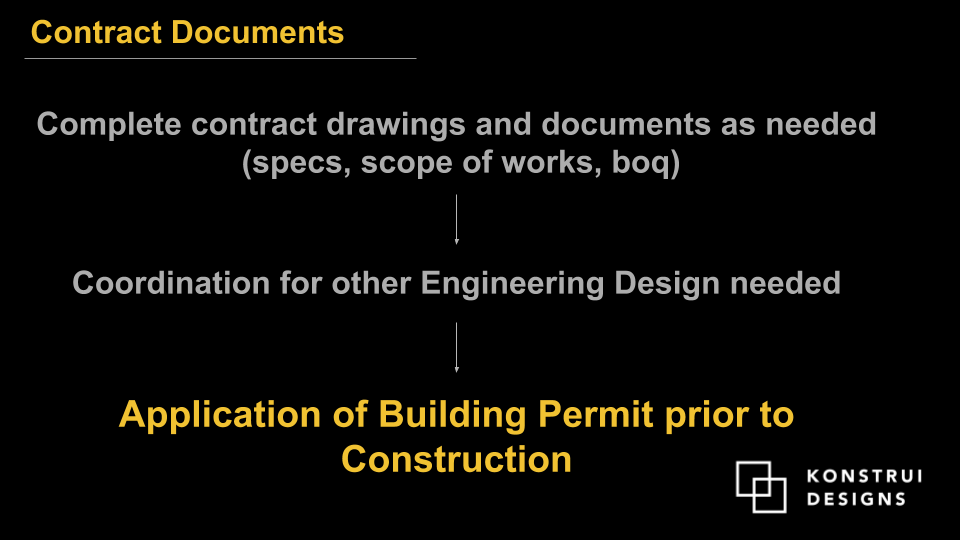
Contract Documents are most required for application of building permits whether by the municipality or building admin where the space/unit is located. This is also needed by the contractor and other suppliers as reference for their quotations and during execution. Included in the documents may be the ff depending on the requirements:
1. At most the 90% working drawings (though some admin is good with just the minimal architectural contract drawings.
2. Technical Specifications. Our team is trained in doing specifications using CSI Masterformat. This document is read alongside with the contract drawings. It is a detailed document providing information about requirements, installation procedure, and technical standard for all materials, products and practice during construction. Most often, this is required for the application of building permit.
3. Scope of Works. A scope of work is drafted by our team to list down all the needed construction works on site. This is a document in which the contractor can based their quotation with. It is a useful document as the client and our team can use this to review the work of the contractor.
4. BOQ. A Bill of Quantity is needed for the application of building permit or as a basis when a client wants to take out a loan from a private bank or a government institution. For bidding purposes, this can also be used to compare quotes and award a contractor.
In addition, we have Engineer consultants to work on the different required MEPFS (Mechanical, Electrical, Plumbing, Fire and Safety), though their services are generally not included in our contract and is on an as-needed basis only.
Output Deliverables: Complete Working Drawings and Documents

Our team will assist in project bidding and awarding of contractors, sub-contractors and suppliers as needed.
After awarding, a pre-construction meeting will be held signifying the start of the construction phase. During this stage, constant monitoring (depending on the agreed # of site visits) of the project will be done. This is also the stage where we will do the sourcing and procurement of Owner Supplied Materials (OSM). A project schedule is helpful to track progress of the contractor and know when other sub-contractor and/or suppliers can now go to site for installation and/or delivery of items.
Before final cleaning (either by the contractor or a hired professional post-construction cleaner (most recommended)), our team will do punch listing on site for the contractor to rectify.
Output deliverables: Project Schedule, Material Board (as needed), Mock-up of furniture and built-ins, Weekly Site Visits and Reports, Sourcing/Procurement of OSMs, Punch listing

After post-construction cleaning, items such as furniture, decor and window treatment can now be delivered and installed on site. Along with this, we will now set up all the items of the client bought or existing. And then... PROJECT REVEAL! Client is now ready to move-in. :)
Output Deliverables: Monitoring installation/delivery of Subcontractors/Suppliers, Set-up of OS items and decors.
--------------------------------------------------------
We hope that this can help you in deciding in hiring a designer to do all these works for you! Please let us know if you have any questions and comments. :)

Comments